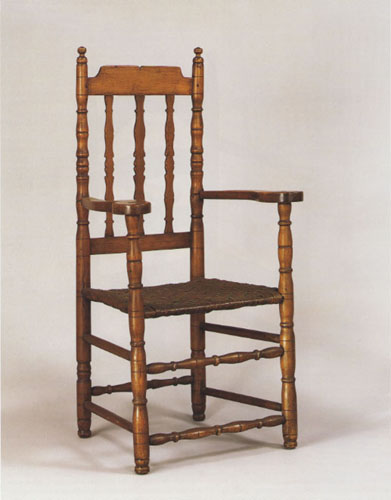
Armchair
Probably Coastal North Carolina, 1720-1770
Maple
Catalog no. 7
By 1700, urban New England chair makers had achieved substantial levels of production. For example, between 1734 and 1746, John Underwood of Boston made 6,180 turned chairs. Records reveal that some of these wares were exported to other regions, including the coastal South.
The only banister-back chair presently attributed to the Carolina Low Country, this example clearly reflects a southeastern North Carolina artisan's efforts to emulate imported New England goods. The chair is reminiscent of contemporary banister-back chairs from the Piscataqua region of coastal New Hampshire and Maine and similar forms made in southern Connecticut. Yet several features confirm its southern origin. Four distinctly turned feet, in-curved arms, and the ornately turned rear stretcher represent common southern approaches.
This chair suggests the manner in which regional styles were absorbed and remolded by artisans working in different cultural contexts. Considered in this light, the chair should not be regarded as a degenerated interpretation of New England tradition; instead, it must be viewed as a North Carolina chair with a strong New England accent.