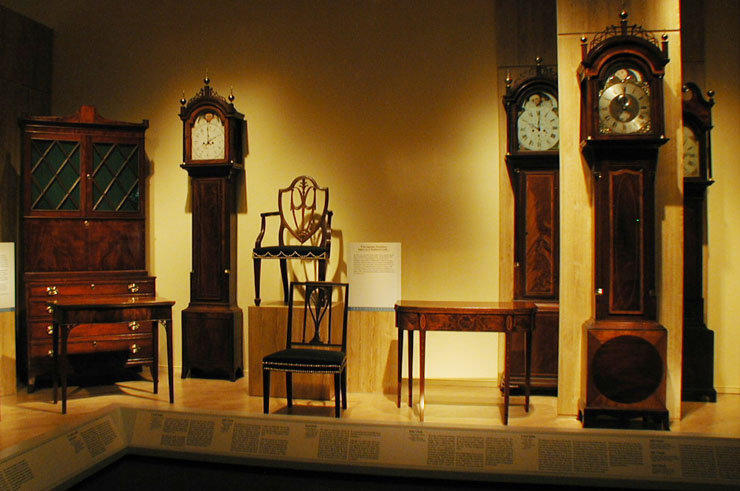


| Secretary and Bookcase |
| Armchair |
| Tall Clock |
| Side Chair |
| Card Table |
| Card Table |
| The distinctive clock case in the center of this trio belongs to a group of early nineteenth-century examples made in Fredericksburg, Virginia, one of the South's most important clockmaking centers after the 1760s. Like other post-Revolutionary Fredericksburg cases, this example is a hybrid of sorts, blending decorative details from clocks made in New England, New York, and New Jersey. The sawn fretwork atop the arched hood is similar to clock cases made in the Boston area, which are epitomized by the case on the left. The oval-inlaid trunk door and the base with its prominent circular motif are direct reflections of designs from New York and New Jersey, as seen on the clock to the right. This merging of New England and Middle Atlantic fashions is without parallel in American clockmaking. It reflects the way in which early national furniture makers in the coastal South increasingly relied on northern designs to keep abreast of the latest styles. |
| Tall Clock (Center) |
A Flood of Northern Imports
The quantity of furniture exported from the North to the South from the 1730s to the 1780s was relatively modest. Shipments increased dramatically toward century's end, due in part to the growing southern interest in neoclassical furniture with its renewed emphasis on curved case forms, veneers, and inlays. By the 1790s, “cabinet manufactories” in Boston, New York, and other cities employed large, highly specialized crews who could produce furniture in the new style cost effectively and in volume.
Most of the northern furniture shipped south during this period was simple and inexpensive. Commonly sold as venture cargo at dockside, the goods were subject to damage in the process. Venture sales were an uncertain business. In 1803, the captain of a New England ship docked at Richmond, Virginia, wrote to Salem cabinetmaker Elijah Sanderson about furniture the artisan had consigned for venture sale:
The goods are not sold as yet [but] part of them are sold. I have tried them twice at vendue [i.e., auction] but sold very little and what is sold is very lo . . . the reason they don't sell quick [is that] their is Ben a vessel here from New York with furniture & sold it very lo.
Unsold goods usually were reloaded and offered at the next port of call.