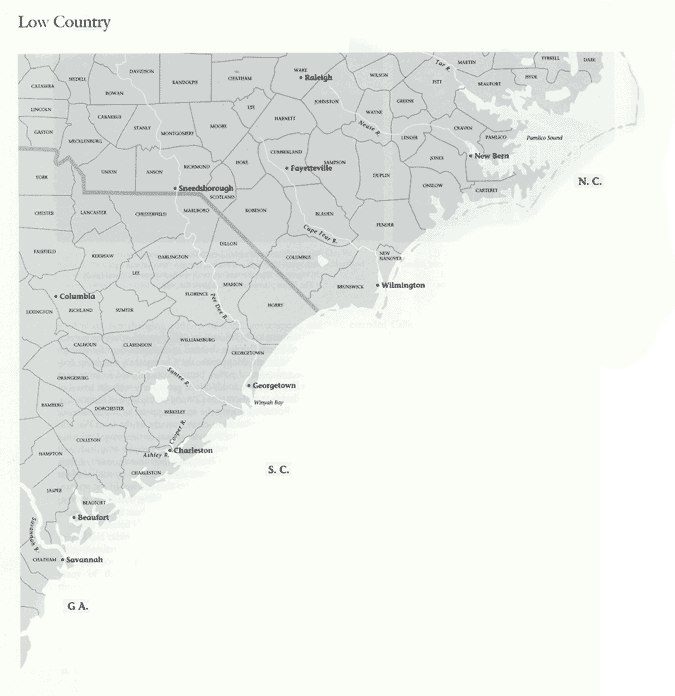
The Low Country
In 1663, Charles II issued a charter for the colonization of Carolina by eight Lords Proprietors. They instituted a constitution centered on the production of plantation crops by indentured and enslaved workers. Having outgrown its first site, the colony's seat of government moved in 1680 to the tip of the peninsula between the Ashley and Cooper Rivers. There they established Charles Towne, or Charleston, as it was usually called after 1783. A deepwater port where the products of the interior were brought for sale and transshipment, Charleston rapidly grew from a small, walled, seventeenth-century outpost to the one of the great eighteenth-century commercial centers in British North America.
The Low Country experienced a steady influx of immigrants. Dutch, French Huguenots, Swiss, Germans, Welsh, Scots, Scotch-Irish, and Sephardic Jews from Spain and Portugal joined English immigrants in fusing an interdependent society unique to the Low Country. While the dominant British culture shaped matters of taste and patterns of consumption most strongly, the presence of the other ethnic groups contributed significantly to the foreign aspect of early Charleston.
The end of proprietary rule in 1729 and the establishment of the colony as a crown province brought economic stability and expansion to the Low Country. Profits from burgeoning rice production and Charleston's participation in the slave trade transformed a settlement described in 1711 as “miserably thin, and disconsolate” to a city praised in 1740 as “a polite agreeable place” in which “the people live very Gentilie and very much in the English Taste.” Fueled by ongoing transatlantic trade connections, the preference for sophisticated British fashions in Revolutionary-era Charleston also reflected the arrival of talented immigrant artisans, including many furniture makers from London, Dublin, and Edinburgh. Charleston's furniture community also benefited greatly from direct trade with the West Indies, from which eye-catching tropical hardwoods, most notably mahogany, were imported.
After the Revolutionary War, the Low Country economy was slowed slightly by the emigration of many wealthy Loyalists and the diminished British market for indigo, the region's most valuable staple crop. New challenges also arose as a result of increased reliance on trade with America's northern ports. While expanding the range of fashionable imported goods and inspiring local makers to increase their repertoire, this trade also provided artisans with considerable competition. Even so, Low Country furniture makers produced a range of neoclassical forms that parallel the finest American examples in structure and style.
Low Country dependence on northern trade continued to grow as a result of the British and French blockades of 1806, Thomas Jefferson's 1807 embargo, the nonintercourse acts of 1809, and the War of 1812. By the 1830s, northern furniture exporters capitalized on the taste of Charleston's elite for imported European goods by producing wares in the continental style. However, a small community of Low Country artisans continued to produce furniture that mirrored the structural and stylistic sophistication of forms made during the region's golden years.


