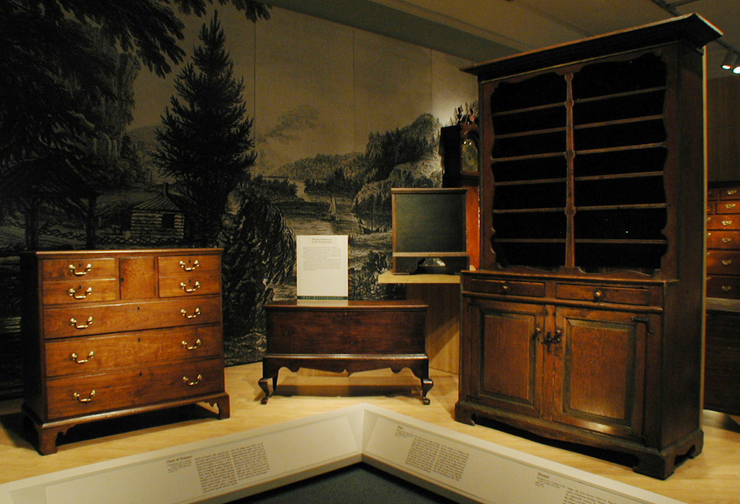
Chest of Drawers
Mecklenburg County or Halifax County, Virginia,
1790-1805
Black walnut with yellow pine
Catalog no. 112
Chests of drawers with exposed prospect doors akin to those on desks were favored by furniture buyers in Mecklenburg and Halifax Counties, a rural district of small farms and large plantations in Virginia's southern Piedmont. Such chests offer new insight into the ways specific British furniture-making traditions were transmitted to the early southern backcountry. Although published pattern books were a common source in coastal centers, emigrating artisans had a greater influence inland. Here, the design source likely was an artisan from East Anglia, that part of England defined by the counties of Norfolk and Suffolk. Virtually identical chests with exterior prospect doors and flanking deep drawers were made there but almost nowhere else. There is little evidence that furniture from East Anglia was imported to North America, although some cabinetmakers and related tradesmen did move from that area to eastern and central Virginia.
Click on chest of drawers for detail.


Chest
Piedmont, North Carolina, probably Randolph County, 1800-1830
Cherry with yellow pine
Catalog no. 108
This chest is part of a large case furniture group that was produced in Piedmont North Carolina from the late eighteenth century until about 1830. These backcountry pieces are readily recognized because of their distinctive appearance. All stand on frames with heavily shaped skirts and short cabriole front legs. On one hand, the pointed spade feet on the front of this chest and the trifid feet on related examples suggest that local tastes were influenced by the numbers of immigrant Irish Quakers who moved to Randolph County and vicinity from Pennsylvania. On the other hand, the short, exuberantly shaped cabriole legs and the use of a separate frame to support the case are reminiscent of British-inspired furniture made in the lower Connecticut River valley. A group of New Light Baptists from that part of New England arrived in the Piedmont in the 1760s.
Click on chest for detail.
British Influences in the Backcountry
”Scotch Irish” is a common but misleading cultural designation. Generally used to describe backcountry residents of British descent, the name fails to recognize the vast cultural differences that separated lowland Scots from their Highland counterparts, or “Ulstermen,”and from other groups around the Irish Sea. Scotch Irish also ignores the divergent views associated with Anglican, Presbyterian, Methodist, Quaker, Baptist, and Catholic sects from Great Britain.
British immigrants often first settled in isolated areas of the backcountry. On a 1768 map of Virginia, one part of the central Valley was dubbed the “Irish Tract.” Even into the early nineteenth century, large sections of the South Carolina Piedmont remained almost exclusively English and Irish. On the other hand, some of became highly integrated, a pattern of cultural blending that is evident in many backcountry furniture forms.