The Furniture of John Shearer
Like furniture painter Johannes Spitler, cabinetmaker John Shearer worked in the northern Valley of Virginia during the late eighteenth and early nineteenth centuries. Today, his work is widely recognized among southern furniture enthusiasts. Shearer's highly individualistic style has prompted many observers to place his furniture outside American cabinetmaking norms. However, such assessments reflect the pervasive Anglocentric character of much American furniture connoisseurship that not only ignores Shearer's ethnic origins but also overlooks the culturally vibrant area in which he worked. Considered in a more balanced cultural context, Shearer's wares emerge as the logical expressions of a Scottish-born furniture maker initially working in the ethnically diverse Shenandoah Valley. His furniture informs modern observers about the maker's personal trade practices and also about the needs and desires of patrons in the backcountry.
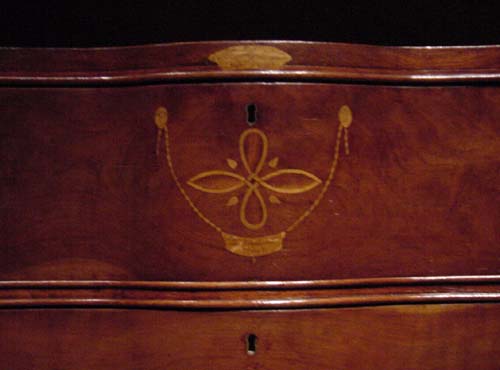
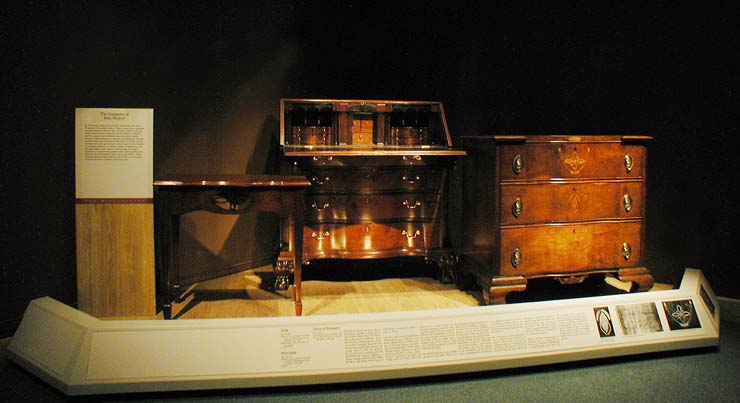
All of the more than two dozen pieces of furniture signed by or firmly attributed to John Shearer share his distinctive proportional sensibilities. Many also reveal his bold carving style. Shearer's furniture bespeaks the hand of an artisan with considerable passion and energy. Made in 1809, the chest of drawers here has an inlaid panel with the British lion rampant topped by a banner reading “Britannia Rules / Rules the Main.” The drawer below bears an inlaid thistle, an allusion to Shearer's native Scotland.
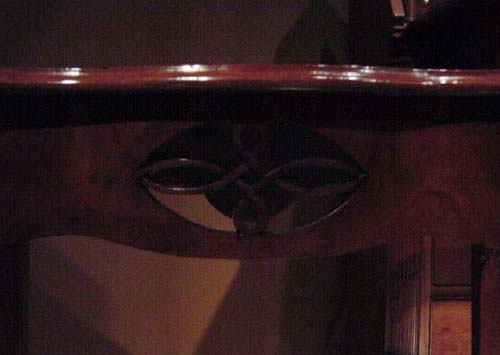
From the earliest years of settlement, individualism was a hallmark of life in the culturally diverse southern frontier. By the time Shearer was working, most backcountry settlers had a well-developed mistrust of eastern political authorities. In this context, Shearer's expressive furniture and strong political beliefs reflect his experience in western Virginia. His Scottish background may only have magnified Shearer's distrust of English authority. The “Federal Knot” inlaid on the chest of drawers and cut into the front skirt of the pier table echoes a popular backcountry criticism of the new, already hopelessly entangled, Federal government.
This Shearer desk represents a highly ambitious artistic effort. With its exuberant baroque sculptural massing, the desk features a dramatic writing interior with rusticated arches and fluted pilasters. Some of the interior drawers are adorned with finely inlaid string swags draped over brass drawer pulls, and the vaulted brackets above the pigeonholes are part of a full-width drawer front cut from a single board. The exterior case is no less striking. A pair of immense quarter-columns whose stop-fluting ends in a bold curve in the manner of furniture from nearby Winchester, Virginia, frames the carcass. Equally powerful are the foreshortened cabriole legs with ball-and-claw feet.
The ever-creative Shearer placed the drawer pulls vertically on the chest of drawers. Often cited as yet another example of Shearer's eccentricity, the technique may instead reflect his desire to align the pulls with the flat end spaces on the reverse serpentine drawers to highlight the overall verticality of the forms. Also, the vertical placement of the pulls makes them easier to grasp. Otherwise, most of Shearer's construction techniques mirror standard conventions.
Shearer's furniture-making legacy is significant from any perspective. As much as any American cabinetmaker, he merged popular urban styles with his own inspired artistic vision. More than mere copies or interpretations of conventional designs, the goods Shearer made considerably expanded the existing regional craft repertoire. They speak strongly of the remarkably diverse context in which he worked, yet they also clearly show the creative mind of this prolific backcountry artisan.


| Desk |
| Chest of Drawers |
| Pier Table |