Ceremonial Chairs
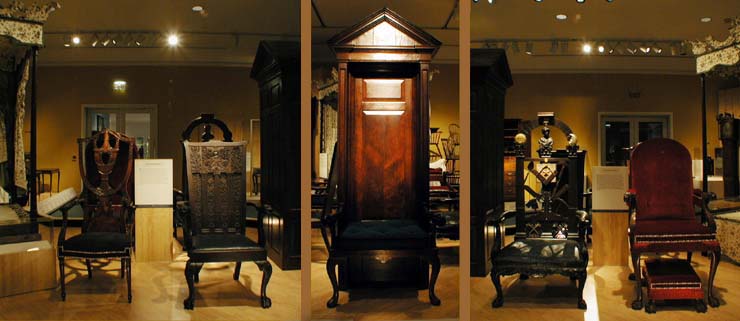
Few objects better illustrate the profoundly deferential and hierarchical nature of colonial society in the South than ceremonial chairs, which both literally and figuratively elevated the leaders of governmental, fraternal, and religious organizations above the crowd. Chairs imbued with ceremonial functions reinforced patterns of social deference and order throughout the British Empire. In domestic settings, the patriarchs of seventeenth-century households occupied joined or turned “great chairs,” while other family members and guests sat on smaller side chairs or stools. A similar hierarchical system came to exist in most public buildings in colonial Virginia. That an impressive selection of ceremonial chairs from eastern Virginia survives speaks strongly about the Old Dominion's emulation of British cultural traditions.
Masonic Chair
Great Britain, ca. 1800
Mahogany with beech and lightwood inlays
Catalog no. 55
This highly unusual British ceremonial chair is one of a pair imported into Charleston, South Carolina, about 1800. Apparently it was used at Union Kilwinning Lodge 4, one of several Masonic lodges that were established there in the eighteenth and nineteenth centuries.
While some southern fraternal, governmental, and religious bodies hired local artisans to produce ceremonial chairs, other organizations preferred to order pieces from Britain, reflecting the South's deeply rooted cultural and economic ties to Britain that proved remarkably durable in areas such as the Low Country. This neoclassical Masonic chair was imported long after America had won political independence from Britain and despite the fact that early national Charleston supported a substantial, highly sophisticated cabinetmaking community quite capable of making such articles.
Masonic Master's Chair
Benjamin Bucktrout
Williamsburg, Virginia, 1766-1777
Mahogany with black walnut
Catalog no. 54
Click on chair for detail
In addition to being one of America's few surviving examples of pre-Revolutionary Masonic seating furniture, this Master's chair is also the only known piece of signed Williamsburg furniture. Built by cabinetmaker Benjamin Bucktrout, himself a Freemason, the chair has survived in unusually good condition and retains its original leather upholstery.
The chair exhibits a combination of rocaille ornament and Masonic imagery that sharply diverges from conventional eighteenth-century designs for ceremonial seating. To the informed Mason, however, the elaborately orchestrated chair back visually embodies the fundamental tenets of the organization. Each of the tools and architectural elements carries a particular meaning and therefore is less an ornament than a missive to be read by those in the organization.
Masonic Chair
Great Britain, ca. 1800
Mahogany with beech and lightwood inlays
Catalog no. 55
This highly unusual British ceremonial chair is one of a pair imported into Charleston, South Carolina, about 1800. Apparently it was used at Union Kilwinning Lodge 4, one of several Masonic lodges that were established there in the eighteenth and nineteenth centuries.
While some southern fraternal, governmental, and religious bodies hired local artisans to produce ceremonial chairs, other organizations preferred to order pieces from Britain, reflecting the South's deeply rooted cultural and economic ties to Britain that proved remarkably durable in areas such as the Low Country. This neoclassical Masonic chair was imported long after America had won political independence from Britain and despite the fact that early national Charleston supported a substantial, highly sophisticated cabinetmaking community quite capable of making such articles.
Masonic Master's Chair
Possibly Anthony Hay
Williamsburg, Virginia, ca. 1765
Mahogany
Long-term loan from Williamsburg Masonic Lodge 6
Catalog no. 53
Click on chair for detail
Built for Williamsburg Lodge 6 shortly before the American Revolution, this remarkable Masonic Master's chair evidences the popularity and influence of Freemasonry in colonial America. Freemasons promoted Revolutionary concepts such as the equality of man, the power of reason over dogma, and the existence of natural laws.
Probably made in Anthony Hay's shop, the chair duplicates certain aspects of the adjacent Capitol chair. Note, for example, the similarity in the lion's heads arm terminals and the carving on the arm supports. The deeply carved back, which is formed from one solid mahogany plank twenty inches wide and almost two inches thick, is highly distinctive. Adorned with a variety of carefully carved symbols and decorative elements, the back features Masonic symbols, the arms of the London Company of Masons, and symbolic references to Scotland and England in the form of a thistle and a rose.
Ceremonial Armchair
Williamsburg, Virginia, or Great Britain, ca. 1750
Mahogany and beech
Catalog no. 52
Embellished with naturalistic carved ornamentation, this elegant ceremonial armchair differs considerably from the Speaker's chair. Featuring the same tall proportions of other contemporary ceremonial seating forms, the chair likely was originally accompanied by a matching footstool, re-created here. The chair probably was made in the 1750s for the royal governor of Virginia to use at the Capitol in Williamsburg, although its placement was in building is unclear. Even less clear are the origins of the chair. While it may have been made by a skilled cabinetmakers in Williamsburg during the colonial period, carving and structural evidence also show strong ties to related British traditions. The Capitol chair may have been imported from Britain, as were portraits of the royal family, iron warming machines, coats of arms, and other symbolic items known to have been ordered for the Capitol and the Governor's Palace.
Virginian or British, the chair remains an object of central importance in the study of Virginia furniture, both for its symbolic meaning and because it inspired later ceremonial seating furniture.
Ceremonial Armchair
Williamsburg, Virginia, ca. 1735
Black walnut with tulip poplar and yellow pine
Catalog no. 51
Among the most outstanding eighteenth-century ceremonial chairs is this Virginia example, long known as the “Speaker's chair.” Decidedly architectonic in form, the chair was used by the Speaker of the House of Burgesses during legislative sessions in the Capitol in Williamsburg.
The chair is a direct descendant of the canopied thrones used by early European monarchs, and the covered chairs of British legislative and judicial leaders. The Speaker sat in the present chair, which was placed on an elevated platform at one end of the Hall of the House of Burgesses, while the representatives sat on built-in wooden benches. Fitted with a finished back, the chair was designed to stand away from the wall, a practice reflected in illustrations of similar chairs in British legislative chambers. Missing is the coat of arms that was placed in the tympanum at the top of the chair.


