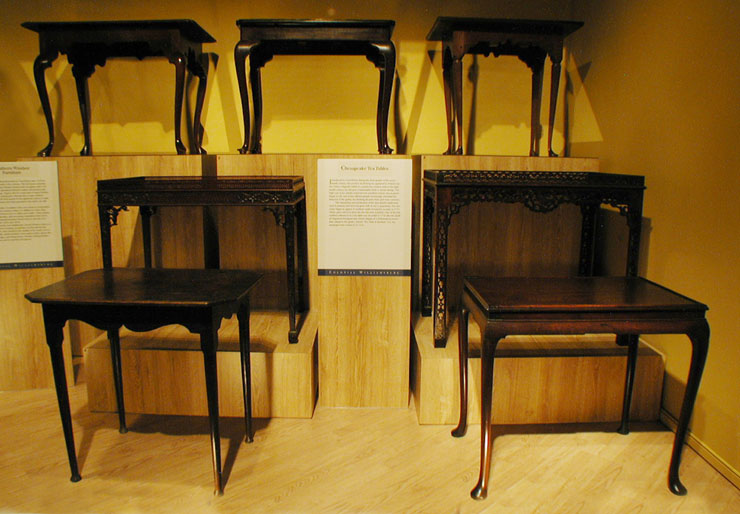
Chesapeake Tea Tables
Introduced in Great Britain during the third quarter of the seventeenth century, the practice of drinking tea appeared in America by the 1690s. Originally billed as a medicinal curative early in the eighteenth century, tea became a fashionable drink in social settings. The high cost of tea initially restricted it to wealthier classes, but as prices began to fall, and as less affluent people increasingly emulated the behavior of the gentry, tea drinking became more and more common.
The importation and production of the specialized implements used to prepare and serve tea grew with its rise in popularity. The new wares began to appear in southern estate inventories as early as 1710. Tables upon which to serve tea also became available. One of the first southern references to a tea table was recorded in 1718 after the death of Huguenot immigrant Jean Marot, keeper of a Williamsburg tavern that catered to the gentry. Marot's “Tea Table & furniture” (i.e., tea equipage) were valued at £1.15.0.
China Table
Williamsburg, Virginia, 1765-1775
Mahogany with oak
Catalog no. 97
Despite the replacement of its gallery, this mahogany china table illustrates an important phase of late colonial furniture production in Williamsburg. The abundant rococo ornamentation and tapered legs verging on the neoclassical give it a British appearance and reflect the design standards of London and other large British urban centers in the 1760s. That such an ambitious project was undertaken in a small town like Williamsburg says much about the abilities and orientation of its furniture makers and about the lofty aspirations of the Virginia gentry.
This piece displays a combination of sawn fretwork and carved fruit, flowers, and foliage. Perhaps the most amazing aspect of this piece is that the delicate foliage on the legs and rails is not integral with those elements but rather carved separately on thin blanks and then glued in place. Castors recessed into the feet indicate the desire for portability in tea and china tables.


China Table
Williamsburg, Virginia, 1765-1775
Mahogany
Purchased with funds given by Mrs. William C. Schoettle
Catalog no. 96
Explaining the use of china tables, English furniture maker and designer Thomas Chippendale wrote in 1762 that they were intended “for holding each a Set of China, and may be used as Tea-Tables.” With their fencelike fretwork galleries, china tables were admirably suited to protect costly tea wares. More important, they offered gentry householders an elegant means of displaying tea china even when it was not in use, thereby affording visitors a visual reminder of the owner's taste, status, and social standing.
This example descended in the Lewis and Byrd families of nearby Gloucester County. Unlike most American china tables, its legs are composed of open fretwork, a costly and time-consuming feature. One of the most puzzling aspects of this design is its opposition to the prevalent regional taste for neat and plain furniture. However, as with Masonic chairs, china tables, and the handful of heavily carved pillar-and-claw tea tables now attributed to Williamsburg, the table served as a central element in an elaborate ceremony. Perhaps their roles as symbolic focal points of important social ceremonies demanded high levels of ornamentation.
Square Tea Table
Attributed to Anthony Hay, Benjamin Bucktrout, or Edmund Dickinson
Williamsburg, Virginia, 1760-1775
Mahogany
Catalog no. 94
This graceful tea table is part of a large furniture group made in pre-Revolutionary Williamsburg, Virginia. Distinguished by the use of well-formed cabriole legs with broad, flattened knees and delicate ankles, the chairs and tables stand on unusual feet that consist of large, relatively thin, round pads raised on high disks of inverted trumpet shape. The same distinctive foot was also discovered on an unfinished easy chair leg excavated from the site of a Williamsburg cabinet shop during archaeological investigations in 1960. The leg may be associated with the first shop on the Nicholson Street site, purchased by Anthony Hay in 1756, or perhaps with Benjamin Bucktrout or Edmund Dickinson, who subsequently worked in the building.
Square Tea Table
Williamsburg, Virginia, 1735-1745
Mahogany and black walnut with oak and yellow pine
Catalog no. 93
Like Western teapots, cups, and other utensils for brewing and serving tea, many of the earliest European and American tea tables were inspired by Asian prototypes. Chinese tables were imported into Europe in substantial numbers as tea became popular.
Sometimes only the basic shape and size of the Asian models were adopted. In other instances, the decorative details were imitated as well, as is the case with the eastern Virginia table illustrated here. Many features are akin to those on Chinese tables and stools produced during the Ming dynasty (1368-1644). The table descended in the Galt family of Williamsburg. Its hand-carved pad feet and cabriole legs mirror a common local approach.
Square Tea Table
Surry County, Sussex County, or Isle of Wight County, Virginia, 1740-1760
Black walnut with tulip poplar
Catalog no. 92
By the mid-eighteenth century, the social consumption of tea long practiced by the gentry had been widely adopted by the “middling sort.” Rural cabinetmakers, joiners, and other woodworkers from Connecticut to the Carolinas responded by producing ambitiously styled vernacular tea tables akin to this one. The broad flattened pad feet and the inset turnings on the legs clearly mark this tea table as a product of eastern Southside Virginia, probably Surry, Sussex, or Isle of Wight County. Black walnut dining, dressing, and tea tables with the same distinctive features have been found there in some numbers.
A hybrid of sorts, the design blends elements from the William and Mary, or mid-baroque, style with those from the newer Queen Anne, or late baroque, taste. While the upper section of the table with its shaped rails and ring turnings harkens back to mid-baroque tables, the simplified cabriole legs were drawn from late baroque objects.
Square Tea Table
Rappahannock River Basin, Virginia, 1755-1770
Black walnut
Long-term loan from William Bradshaw Beverley
Catalog no. 95
This singular tea table descended in the Beverley family of Blandfield plantation on the lower Rappahannock River in Essex County, Virginia. Distinguished by exaggerated cabriole legs, pointed feet, extensively shaped aprons, and double-pinned joints, it belongs to a growing group of Virginia tables and chairs that unmistakably were inspired by Irish furniture-making traditions. Evidence suggests the related pieces are the work of several shops probably near the river port of Tappahannock.
The presence of an Irish cabinetmaker in the counties along the lower Rappahannock cannot be documented, but not every artisan in early Virginia was included in official records. Immigrant Irish furniture makers do appear in documents from other jurisdictions in eastern Virginia.
Square Tea Table
Eastern Virginia, 1720-1730
Black walnut
Gift of Elizabeth and Miodrag Blagojevich
Catalog no. 90
The general shape and size of this early tea table were inspired by Asian traditions, but its ornamentation and production were entirely European. The blocked-and-turned legs and stretchers were produced on a lathe, and the scalloped rails were laid out with a rule and compass and sawn to shape. The frame was mortised and tenoned together, the joints secured with wooden pins, and the top pinned to the frame.
Despite its well-proportioned architectonic legs and shapely rails, evidence on the underside reveals coarse production methods that point to execution by a joiner rather than a cabinetmaker. Southern house joiners often made uncomplicated furniture early in the colonial period.