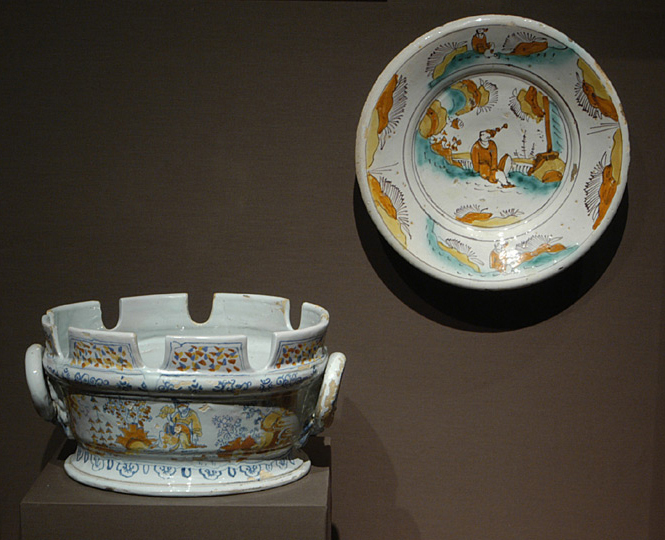
Potters in the production centers of Bristol and nearby Brislington specialized in the use of yellow and orange enamels as well as bright turquoise glazes. The English addition of color to the traditional blue-and-white palette may have been influenced by new types of imported porcelain. In 1683 the Chinese Imperial kilns reopened after a civil war and began producing wares adorned with green, red, and yellow enamels, which in the West came to be known as Famille Verte. Japanese wares with dark red and gold colors—called Imari—and with light blue, orange, and yellow enamels—called Kakiemon—first appeared in Europe even earlier. English potters adapted these imported patterns using the colorful enamels they already applied to European style tin-glazed ceramics.
Plate, 1680–1700
Brislington or Bristol, England
Tin-glazed earthenware
Lent by a private collection
Monteith, 1680–90
Brislington or London, England
Tin-glazed earthenware
Lent by the Chipstone Foundation 1993.20