…take one half of good Kitchen-Garden-Earth, a quarter part of Mould and a quarter part of Rubbish; mix the whole together, and fill your Boxes wherein to put your Olive Plants therewith.
M. Chomel, Dictionaire Oeconomique, 1725 edition
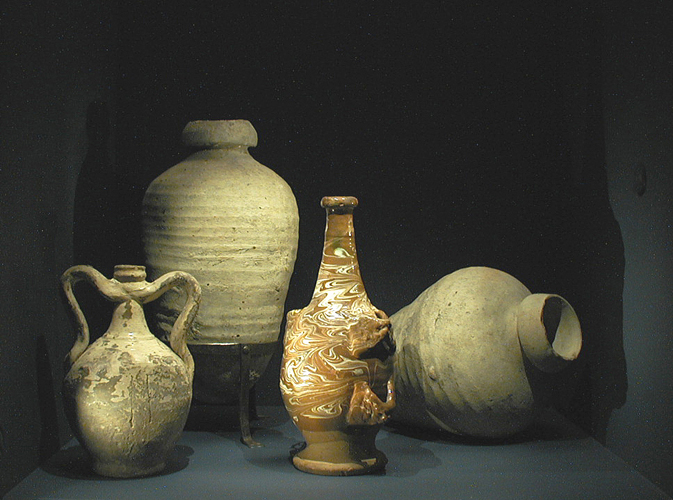
Despite such explicit instructions, growing olive trees in England was difficult. It was much easier to import one’s olive oil from Spain or Italy—as Monsieur Chomel went on to explain. The shapes and varieties of these jars and flasks are typical of those in which olive oil was imported into England and America in the seventeenth century. The first three examples are probably from Seville. One of these (3) is adorned with colored crosses, which have yet to be explained, and also displays the carved initials of its owner.
The fourth flask shown here (4) was made in the vicinity of Pisa in the second quarter of the seventeenth century.
Although of superior quality, such decorative wares were widely exported to Europe and America. Fitted with lionesque handle loops for suspension from a cord, the red body is coated with a marbleized white slip under a clear lead glaze.
1. Jar, earthenware. Seville, Spain, ca. seventeenth century.
2. Jar, earthenware. Seville, Spain, ca. seventeenth century.
3. Flask, earthenware. Marked IE. Seville, Spain, ca. seventeenth century.
4. Flask, lead-glazed earthenware. Vicinity of Pisa, Italy, second quarter of the seventeenth century.

