
 |
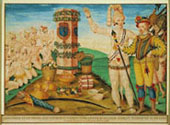
| Figure 3 Jacques Le Moyne de Morgue, Réné de Laudonniére and the Indian Chief Athore Visit Ribaut’s Column, probably Paris or London, 1564. 4" x 10". Gouache and metallic pigments on vellum. (Courtesy: Print Collection, Miriam and Ira D. Wallach division of Art, Prints and Photographs, The New York Public Library, Astor, Lenox and Tilden Foundations). Le Moyne was a member of the French expedition that settled at Fort Caroline on the St. John’s River in 1564. Although the colony failed in less than a year, Le Moyne survived and returned to Paris. In 1572, he escaped the Massacre of St. Bartholomew’s Day and fled to London. Encouraged by Sir Walter Raleigh, Le Moyne began drawing and painting plants, insects, and scenes of Indian life remembered from his voyage. His watercolor of commander Réné de Laudonniére and Chief Athore visiting the column erected by the first French expedition is an idyllic depiction of Europeans and Native Americans sharing the riches of the New World. This imagery must have held special meaning for Le Moyne and other Huguenots, who undoubtedly saw America as a place of opportunity and sanctuary (Jessie Poesch, The Arts of the Old South: Paintings, Sculpture, Architecture & the Products of Craftsmen, 1560–1860 [New York: Harrison House, 1983], pp. 3–7). |