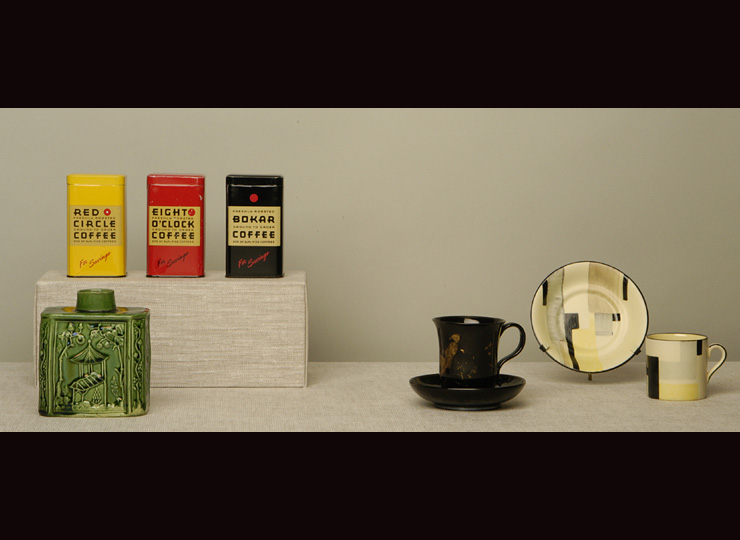
Tea leaves and coffee beans both gradually lose their flavor when exposed
to air. The green ceramic tea canister seen here would originally have had
a tight-fitting silver or pewter lid that kept moisture from hydrating the
dried leaves. Similarly, coffee sellers in the late nineteenth century developed
the vacuum-packed can and the one-pound coffee bag. The Great Atlantic and
Pacific Tea Company—better known as A&P stores—hired industrial
designer Egmont Arens to create modern-looking airtight tins for its three
grades of coffee. The bold designs became so iconic that A&P adapted them
into promotional coin banks.
The French word “demitasse” (for “half-cup”)
was adopted by English speakers around 1840 to describe small cylindrical
cups used for serving strong French-style coffee. Susie Cooper’s hand-painted
Art Deco design emphasizes the overall geometry of the demitasse form. A softer,
curved precursor is seen in the black earthenware coffee cup to the left,
whose gilt floral decoration is partially lost today but which originally
would have glittered brilliantly on a candlelit tea table.
Tea Canister, ca. 1765
Staffordshire, England
Earthenware (creamware)
Lent by the Chipstone Foundation 1997.7