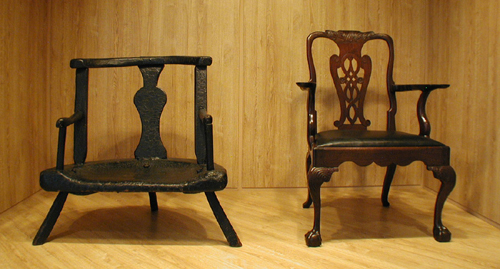
Armchair
Maryland, possibly Anne Arundel County, 1770-1800
Tulip poplar and oak
Catalog no. 45*
Boldly proportioned and rooted in ancient woodworking traditions, this Maryland chair has a long history at Traveler's Rest, the eighteenth-century plantation home of Philip Hammond near Annapolis. The chair is markedly different from most eighteenth-century American seating furniture. The form closely resembles low-seated chairs and stools from rural England, Ireland, and especially Wales. It is a reminder that British settlers came not just from London but from all parts of the British Isles.
Welsh chairs of this form typically were used in cooking and other hearth-oriented activities. Their low stance placed the sitter near the fire where most hearth cooking was done, and three rather than four legs provided stability on uneven brick or earthen floors. The Maryland chair, which has a strong tradition in the Traveler's Rest kitchen, likely functioned that way.
*Catalog numbers in this exhibit refer to objects discussed in Southern Furniture 1680-1830: The Colonial Williamsburg Collection.
Armchair
Edenton, North Carolina, 1745-1765
Mahogany with cherry and yellow pine
Catalog no. 11
Like the Welsh-style hearth chair to the left, this coastal North Carolina chair is unusual by American design standards. Its distinctive splat pattern is unknown on other American chairs outside of those produced in Edenton, and its square-section cabriole rear legs diverge from colonial norms. Even the carved upper surfaces of the arms, now considerably worn, are found on only a small number of early American chairs.
The chair is an example of the South's strong cultural ties to Great Britain since chairs of the same form were produced in several British shops. The pattern likely came to America in one of two ways: a local artisan copied an imported chair, or an immigrant British cabinetmaker constructed it. Both practices were common in the coastal South and indicate ways in which the dominance of British taste was regularly reenforced in the region.


Reminder: Click on objects for overall photograph and museum label.