Why Is There So Little Southern Furniture?
The South's largely rural population and agrarian economy supported fewer cabinetmakers than the more urbanized North did. Yet research by the Museum of Early Southern Decorative Arts has identified several thousand southern joiners and cabinetmakers who worked before 1820. These artisans produced far more furniture than most people realize.
In spite of such volume, the survival of southern furniture has been hindered by the region's warm, damp climate. Fluctuating temperatures and high humidity levels wreak havoc with organic materials like wood. When Maryland planter Charles Carroll ordered furniture from England in 1768, he admonished his agent to ensure that “if [there is] any Carved ornament to the mouldings they are Desired to be solid and not Glued on[,] such work being very apt to Come to pieces here.”
The Civil War further reduced the survival rate of cabinet wares made in the South. Untold quantities of furniture were lost in wartime fires like those that destroyed Richmond, Virginia, Columbia, South Carolina, and other cities. Both armies burned hundreds—perhaps thousands—of rural houses throughout the region. After the war, Reconstruction-era politics and the devastation of the southern economy led to widespread poverty that persisted into the early twentieth century. As a result, antiques were often used up or sold to raise funds. Boston antiques dealer Israel Sack noted in a 1930 letter to a Colonial Williamsburg official, “In my travels through the South, I find that some of the finest old families there are obliged to part with their most valued possessions.”
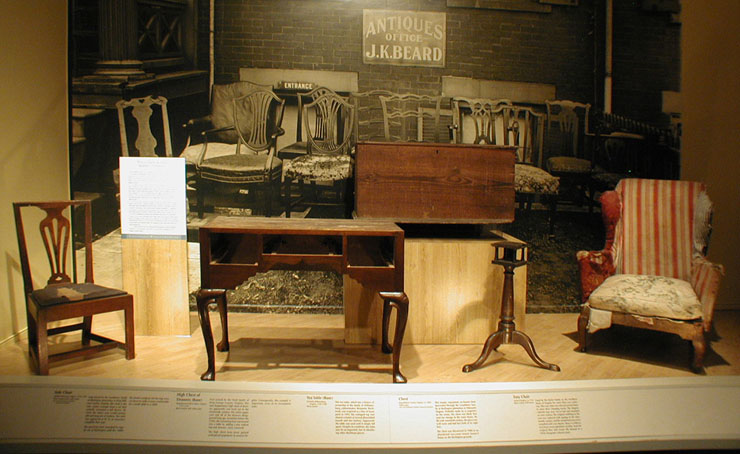
These factors not only reduced the amount of extant southern furniture, but frequently left it in the same condition as the objects shown here.
| Side Chair
Middle Peninsula, Virginia, 1760-1780
Black walnut with yellow pine
Gift of the Burlington-Gwathmey Memorial Foundation
Reminder: Click on chair
for museum label.
|
High Chest of Drawers
(Base)
Rappahannock River Basin,
Virginia, 1745-1765
Black walnut with yellow pine
Reminder: Click on fragment for museum label. |
Tea Table
(Base)
Probably Williamsburg, Virginia, 1760-1780
Black walnut
Reminder: Click on fragment for museum label.
|
Easy Chair
Eastern Virginia,
ca. 1745
Black walnut with beech
Reminder: Click on Chair for museum label. |
Chest
King William County, Virginia, ca. 1800
Yellow pine
Gift of the Burlington-Gwathmey Memorial Foundation
Reminder: Click on chest for
museum label. |


