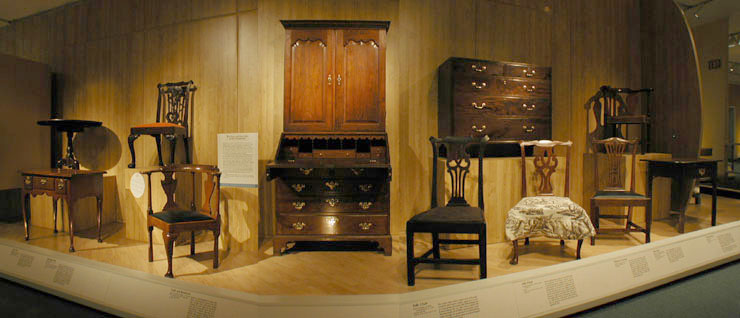
| Round Tea Table
Chowan County, North Carolina, probably Edenton, 1750-1780
Mahogany
Catalog no. 99 |
Dressing Table
Southeastern Virginia, 1735-1750
Black walnut with yellow pine, hackberry, and red cedar
Catalog no. 82 |
Side Chair
Attributed to Peter Scott
Williamsburg, Virginia, 1745-1755
Mahogany with beech
Catalog no. 15 |
Smoking Chair
Tidewater Virginia, 1740-1750
Black walnut
Gift of Mr. and Mrs. Leonard William Ballard from the estate of Mary Wrenn Cofer Ballard in honor of her daughters, Mary Wrenn Ballard Oliver and Anne Lewis Ballard Weaver
Catalog no. 9 |
Desk and Bookcase
Central Southside Virginia, 1770-1800
Black walnut with yellow pine, oak, and tulip poplar
Catalog no. 141 |
Side Chair
Rappahannock River Basin, Virginia, 1760-1775
Cherry
Long-term loan from William Bradshaw Beverley
Catalog no. 18 |
Side Chair
Attributed to Edmund Dickinson
Williamsburg, Virginia, 1770-1776
Cherry with oak
Gift of William Byron Bailey in memory of Dorothy Tazewell King Bailey
Catalog no. 26 |
Writing Table
Roanoke River Basin, North Carolina,
1770-1790
Black walnut with yellow pine and oak
Catalog no. 87 |
| Smoking Chair
Eastern Virginia, 1765-1785
Black walnut
Gift of Elizabeth Gribbel Corkran in memory of John Gribbel
Catalog no. 21 |
| Chest of Drawers
Petersburg, Virginia, 1780-1795
Mahogany with yellow pine
Catalog no. 111 |
The neat and Plain Style in the Chesapeake
A style known as neat and plain gained favor in some quarters of British society late in the second quarter of the eighteenth century. Developed partly in response to the excesses of the French rococo style, the neat and plain fashion emphasized the same use of clean lines, minimal ornamentation, and classical proportions that characterized much British architecture. Contemporary dictionary references defined neat and plain as “free from what is unbecoming, inappropriate, or tawdry; of simple elegance; tasteful and refined.”
The British-oriented Chesapeake gentry readily adopted this new style. Their orders repeatedly requested furniture that was “plain but neat.” In the 1770s, Virginia planter Robert Beverley ordered a great deal of English furniture for Blandfield, one of the grandest houses in Virginia. Among the things he sought were “a neat plain Table for a Tea Table, & a neat Mahogany tea board,” “one Dozn plain mahogany Chairs . . . for a dining room,” and “a Neat looking Glass . . . in a neat white Frame for my drawing room.” Beverley admonished his agent: “The furniture I beg may be [as] neat and plain as possible.” When Charles Carroll of Mount Clare plantation, Maryland, ordered goods in 1767, he noted: “as they are for my own use I would have them of the best sorts—the furniture of the neat Plain fashion and Calculated for Lasting[,] nothing of the Whimsical or Chinese Taste which I abominate.”
Taking note of such aesthetic concerns, Chesapeake cabinetmakers produced vast quantities of elegant neat and plain furniture like that exhibited here.