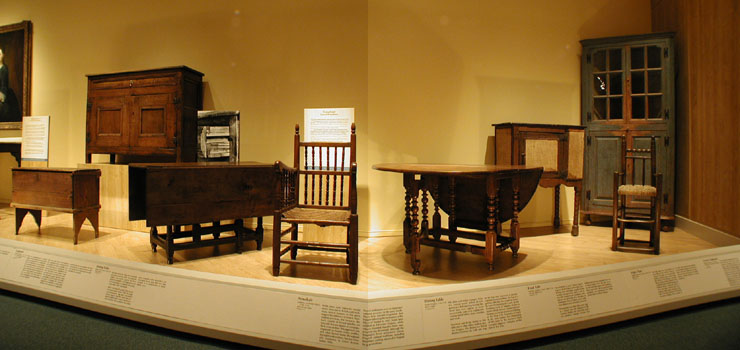
Reminder: Scroll your mouse over objects on display for identification labels. Click on objects for overall photo and complete museum label.
| High
Chair Middle Tidewater Virginia, 1700-1750 Black walnut Catalog no. 3 |
| Corner
Cupboard Tidewater Virginia, 1735-1745 Yellow pine, tulip poplar, and black walnut Catalog no. 150 |
| Food
Safe Southern, possibly Virginia, 1680-1720 Ash and yellow pine Catalog no. 147 |
| Dining
Table Eastern Virginia, 1700-1730 Black walnut Catalog no. 56 |
| Armchair Southern, Southside Virginia, 1700-1750 Ash and red cedar Catalog no. 2 |
| Dining
Table Eastern Maryland, 1740-1755 Black walnut Catalog no. 57 |
| Cupboard Tidewater Virginia, 1680-1710 Black walnut with yellow pine and tulip poplar Catalog no. 148 |
| Chest Southern, probably Southern or Eastern Virginia, 1680-1730 Black walnut and yellow pine with oak Catalog no. 104 |
Turned and Joined Furniture
With its refined structural joints and surface finishes, the art of cabinetmaking
did not become widespread in Europe and America until the 1720s. Prior to
that time, most furniture was made by joiners, the same artisans who built
everything from boxes to houses. Joiners often worked with professional turners,
who made the lathe-turned legs on many joined tables and other furniture forms.
The Chesapeake was home to many joiners and turners in the seventeenth and
early eighteenth centuries, most of them English, Irish, Scottish, or French
Huguenot immigrants. Because the Chesapeake lacked urban centers in the 1600s,
these artisans operated in relative isolation which inhibited development
of the specific local woodworking traditions that characterize contemporary
New England furniture. As a consequence, it is often difficult to determine
the maker or place of origin of the earliest furniture produced in the Chesapeake.