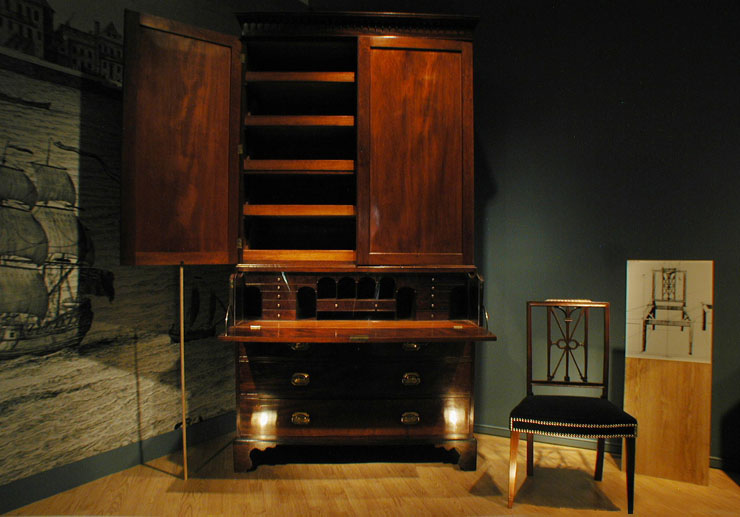
Clothespress with Secretary
Thomas Lee and [P. J.?] Grimball
Charleston, South Carolina, 1804-1813
Mahogany with white pine, red cedar, tulip poplar, and yellow pine
Catalog no. 125
Among the transplanted craftsmen who arrived in post-Revolutionary Charleston was Scottish cabinetmaker Thomas Lee (ca. 1780-1814), who built and signed this mahogany clothespress. Lee's British training is apparent in both the overall form and the details of this press. With its secretary drawer and removable cornice, the piece parallels many surviving British examples. The resemblance was heightened by Lee's decision to model parts of the press on illustrations in The Cabinet-Makers' London Book of Prices, and Designs of Cabinet Work, an English manual first issued in 1788 and expanded in 1793 (see graphic).
Lee was working in Charleston by 1804 and remained there until his untimely death at age thirty-four. One of many local cabinetmakers of Scottish origin, Lee ran a moderate size furniture business. Built for the wealthy Ball family, this clothespress is similar to other Charleston-made examples in several ways. Although unusually conservative in style, its great height (nearly eight feet) and the inclusion of a secretary drawer are typical of Charleston presses of the early national period.


British Taste in Federal Charleston
The Revolutionary War signaled the end of British cultural domination in some regions. Yet some Americans continued to regard British goods as the ultimate symbols of a refined lifestyle. Such was the case in Charleston. Writing about the 1790s, South Carolina governor John Drayton observed in 1802 that “Charlestonians sought in every possible way to emulate the life of London society. They were too much enamored of British customs, manners and education to imagine that elsewhere anything of advantage could be obtained.”
Gentry householders in post-Revolutionary Charleston regarded the high cost of importing sophisticated London furniture as no object. Those who were unable or unwilling to order furniture from London still had access to British-style cabinet wares of a more restrained nature through the many artisans who arrived in the decades after the war and proudly announced their British training.
Side Chair
Charleston, South Carolina, 1800-1815
Mahogany with ash and white pine
Catalog no. 37
The form of this chair, like so many other pieces of southern furniture, appears to have been inspired by a British design manual. The splat and crest rail closely resemble those in a small image in “Houses & Chairs in perspective,” the illustration for a drafting lesson in Thomas Sheraton, Cabinet-Maker and Upholsterer's Drawing Book (1793)(see graphic). That illustration seems to have been the inspiration for other southern chairs as well.