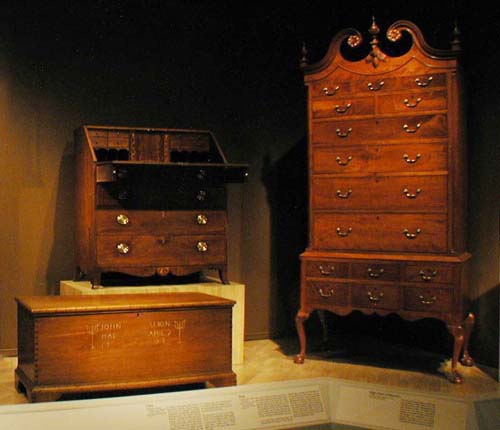
Desk
Augusta County, Virginia, 1805-1815
Black walnut with yellow pine, tulip poplar, butternut, and maple
Catalog no. 137
The exterior of this backcountry desk mirrors many British-inspired neoclassical desks made in coastal centers in the South. The desk is adorned with delicate string inlays on the drawers, flared French feet, and a-color contrasted inlaid fan on the skirt made of butternut and maple. Much of the structural evidence, indicates the maker's familiarity with German-American craft traditions, however.
As on many other backcountry desks, the dovetail joints on the top are fully exposed, and the battens on either end of the fall board are through-tenoned. The drawers are supported on thin drawer runners instead of the full dustboards used in coastal furniture. Even the inlaid vine and flower motif on the document drawers parallels German-American craft motifs. This likely reflects the desk's original ownership in the family of George M. Coiner (1758-1840), a German farmer who moved to Augusta County from Pennsylvania late in the eighteenth century.
Click on desk for detail.


Chest
Shenandoah County or Pendleton (now Highland) County, Virginia, 1793
Black walnut with yellow pine
Catalog no. 105
In contrast to the simple nail construction used to join the earliest American chests, post-1725 examples increasingly employed more technically sophisticated dovetailed cases. On coastal southern furniture, dovetails and other structural features often were concealed behind complex miter joints or thin veneer strips. In contrast, backcountry furniture often displays such structural evidence conspicuously. The exposed dovetails and large iron hinges riveted through the lid indicate the sound construction of this chest. In a similar way, many wooden pins secure the lid and base moldings and create an undulating dot pattern across the top and bottom of the case.
The importance of chests in the backcountry is revealed by the common application of inscriptions and colorful ornamentation. Here, the inscription “John Siron / Mad[e] April 2 / 1793” likely refers to the owner rather than to the maker.
Click on chest for detail.
Furniture Construction in the Backcountry
Furniture collectors and scholars have long relied on stylistic evidence to determine the regional origin of early American furniture. Just as informative, but less often considered, is the internal construction of the pieces. Significant structural differences distinguish British-inspired coastal southern furniture from rural European-inspired backcountry furniture.
Until recently, thoughtful consideration of inland furniture-making traditions has been hindered by the British standards traditionally used to evaluate early American furniture--standards that offhandedly dismiss backcountry furniture as heavily proportioned and unrefined. Far more informative, however, is an exploration of how the construction of backcountry furniture reflects the region's complex cultural character as well as its simultaneous promotion of Old World craft ways and the latest urban fashions.
High Chest of Drawers
Frederick County, Virginia, ca. 1795
Cherry with yellow pine
The strong Pennsylvania cabinetmaking traditions that influenced the external surface and ornamentation on this northern Valley of Virginia high chest also dictated its structural details. As in Pennsylvania work, all of the drawers are supported on dustboards. The upper case is dovetailed together, while the base was assembled with pinned mortise-and-tenon joints.